

On the latest SEC “Material Matters” podcast on October 16, 2026, Chairman Paul Atkins and Enforcement Director David Woodcock laid out a “back to basics” agenda: cases built on real investor harm and intentional misconduct, fewer cases premised on unclear rules, and a reorganized Division designed to investigate faster and with more specialized expertise.
The message cuts both ways. The SEC is signaling restraint toward good-faith mistakes, but it is also sharpening the tools it uses to identify, investigate, and litigate the cases it pursues. The record you build before the SEC calls and how you respond when it does matter more than ever.
Key Takeaways
- Intent and harm now drive charging decisions. The Division will measure success by case quality, not case counts. Contemporaneous evidence of good faith is now among your most valuable defenses.
- Good faith covers a mistake, not a pattern. Leadership will be “very careful” about second-guessing honest errors, but repeated, uncorrected deficiencies, especially those flagged in exams, are an express enforcement target.
- “Rules first” on AI is not a safe harbor. The SEC prefers to address emerging technology through rulemaking, but misleading AI and crypto claims and AI-enabled fraud remain priorities.
- Assume any insider trade will be detected. The Director warned that the Market Abuse Unit’s surveillance will catch even small, one-time trades.
- Accounting cases are getting a specialist team. A new national Financial Reporting and Accounting Unit and a new Office of AI and Analytics point to faster, more sophisticated scrutiny of financial reporting judgment calls.
- The Wells process carries more weight. The Trial Unit now reports directly to the Director, and Wells recipients have four weeks to respond. A well-built litigation-risk submission is a real opportunity to shape whether a case is filed.
- Parallel exposure is broadening. Criminal referral is assessed from the start of an investigation, and a new SEC-FDA MOU targets gaps between issuers’ public statements and their FDA communications.
Intent and Investor Harm, Not Case Counts
Director Woodcock defined “back to basics” as a focus on “real investor harm,” “real intentional misconduct,” and opportunities to return money to investors. He framed enforcement as one part of the SEC’s three-part mission, one that should avoid “squashing innovation” or discouraging people from “taking good risks.” Chairman Atkins added that ending regulation by enforcement means setting clear rules up front rather than suing people on the theory that they “should have known” what was unclear.
The Division will be “very careful second-guessing good faith mistakes” and will no longer be judged by “a single number,” the total count of actions brought. That restraint has a limit: repeated mistakes, the Director noted, make it “hard to decide whether it’s just a mistake or whether it’s intentional.”
What this means: We expect scienter and investor harm to carry even more weight in staff charging recommendations, and purely technical violations to draw less attention. Contemporaneous documentation of key judgment calls, reliance on counsel and auditors, and prompt remediation are the evidence most likely to persuade the staff that a problem was a mistake, not misconduct.
Emerging Technology: Rules First, Fraud Still Fair Game
Director Woodcock said AI is “emerging very quickly” and is “probably better” addressed through rules first, but that this “doesn’t mean we don’t bring cases around emerging technologies. We absolutely do.” The target is people who use innovative technology “to rip people off.”
He pointed to a December 2025 action in which social media ads steered investors into WhatsApp chats promoting a purported crypto trading platform run on “AI investing models.” The promoters used fake SEC registration links, AI-generated comments, and AI-generated “professors,” then charged a fake “processing fee” when investors tried to withdraw. These cross-border schemes often target older investors, and money sent overseas is very hard to recover.
What this means: Firms marketing AI- or crypto-related products should expect continued scrutiny of unsupported claims (“AI washing”). Firms whose names or registrations could be borrowed in impersonation schemes should monitor for misuse and have an escalation path in place.
The Core Docket Is Unchanged
Director Woodcock identified the areas that will “always” anchor the program:
- Offering frauds and Ponzi schemes, often brought in parallel with criminal authorities.
- Insider trading. The Market Abuse Unit’s surveillance capabilities are, in his words, “not present anywhere else in the world,” and “if someone engages in insider trading, they’re going to get caught,” including small, one-time trades. Chairman Atkins cited a matter in which the FBI detained two Hong Kong-based individuals at the airport after the Market Abuse Unit identified them.
- Investment adviser conflicts of interest and failures to disclose material information to investors.
- Financial reporting fraud, including unlawful earnings management and seriously deficient internal controls at public companies and, where jurisdiction exists, private companies.
- Repeated, uncorrected control failures. Registrants and public companies that fail for years to fix serious exam-identified deficiencies may face enforcement, because “sometimes it’s better to get in there before the investors blow up.”
A Reorganized Division
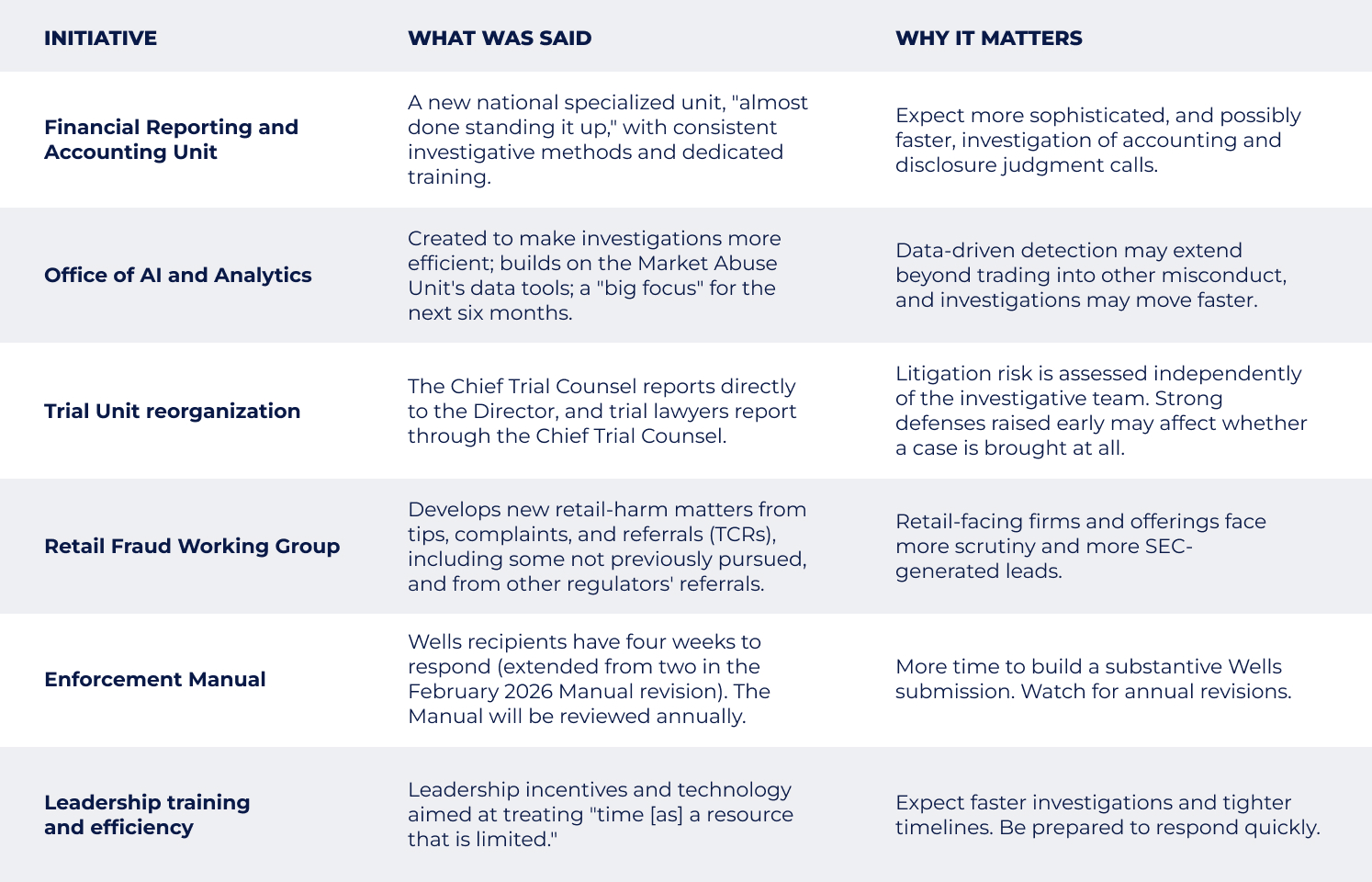
Triage, Referrals, and Parallel Proceedings
With “tens of thousands” of TCRs a year and about 1,100 staff (roughly 500 of them line investigators and accountants), the Division triages through its Office of Market Intelligence based on the size of investor harm and the age of the misconduct, referring some matters to FINRA or the States. Ten regional offices supply local expertise, such as Fort Worth for oil-and-gas fraud and San Francisco for technology, while specialized units such as Asset Management work across offices.
The Division works closely with DOJ, the FBI, U.S. Attorneys’ offices, FINRA, the CFTC, and the States, and assesses throughout an investigation whether to make a criminal referral, because “sometimes people only respond to the threat of prison.” The Director also highlighted coordination with the FBI and DOJ on border watches for suspects who may flee, and a new MOU with the FDA aimed at gaps between companies’ public disclosures and what they tell, or hear from, the FDA.
What this means: Evaluate parallel criminal exposure at the outset of any SEC matter, not after a Wells notice arrives. Life sciences issuers should confirm that public statements about regulatory interactions track their FDA correspondence.
Treat an Exam as an Exam
Director Woodcock stressed that the Division of Examinations is a separate program and that most exams do not lead to enforcement referrals. His advice was blunt: “when you have an exam, you should treat it as an exam, not as an enforcement action. Because if you treat your exam like an enforcement action, you make it one.”
What this means: Engage cooperatively with exam staff and fix deficiencies promptly. The fastest way to turn an exam into an enforcement matter is to leave the same findings open year after year.
What To Do Now
- Document good faith. Keep contemporaneous records of significant judgment calls in financial reporting, revenue recognition, and disclosure controls, including the advice of counsel and auditors.
- Close out deficiencies. Track exam and internal audit findings through remediation and escalate repeat findings to management and the board.
- Tighten insider trading controls. Review pre-clearance procedures, blackout periods, and how third parties such as filing agents and consultants handle material nonpublic information.
- Substantiate AI/SI and crypto claims. Confirm that marketing and disclosures about emerging technologies are accurate and supported.
- Advisers: revisit conflicts. Reassess how you identify and disclose conflicts of interest, a constant enforcement priority.
- Life sciences issuers: align with the FDA record. Reconcile public disclosures with FDA correspondence in light of the SEC-FDA MOU.
- If the SEC calls, engage experienced counsel early. Assess parallel criminal risk immediately and use the full four-week Wells period to present litigation-risk arguments the Trial Unit can weigh independently.
How CM Law Can Help
Our White Collar, Securities Enforcement & Investigations team includes a former SEC enforcement regional trial counsel. We represent companies, advisers, and individuals in SEC exams, investigations, Wells submissions, and parallel criminal matters, and we help clients build compliance records that hold up under scrutiny.
A note on terminology. The SEC’s transcript states that the episode was recorded before the September 29, 2026 Executive Order “Inaugurating the Era of Super Intelligence,” which directs federal agencies to use “Super Intelligence” and “SI” in place of “Artificial Intelligence” and “AI,” and that the SEC now follows the order. This alert uses “AI” to match the original wording in the interview.
This alert is based on the SEC’s published, lightly edited transcript of the “Material Matters” episode. The SEC advises reviewing the episode audio before quoting from the transcript. This alert is for informational purposes only and does not constitute legal advice. For questions, please contact Mike Piazza or your CM Law relationship Partner.
CM Law (cm.law) – formerly Culhane Meadows – is the largest national, full-service, women-owned & managed (WBE) law firm in the United States. Designed to provide experienced attorneys with an optimal way to practice sophisticated law while maintaining a superior work/life balance, the firm offers fully remote work options, a transparent, merit and math-based compensation structure, and a collaborative culture. Serving a diverse clientele—from individuals and small businesses to over 40 Fortune-ranked companies—CM Law is committed to delivering exceptional legal services across a broad spectrum of industries.
The foregoing content is for informational purposes only and should not be relied upon as legal advice. Federal, state, and local laws can change rapidly and, therefore, this content may become obsolete or outdated. Please consult with an attorney of your choice to ensure you obtain the most current and accurate counsel about your particular situation.